
Virginia Jail VINE Coverage
Virginia Jail VINE supplies automated custody information and notices for people in participating local and regional jails. VINELink is the public search interface. It is designed for a specific-person check, not a complete statewide list of everyone released. The reporting jail and the person’s identity must be matched before a status is trusted.
A local VINE event describes a change at the reporting jail. Release may mean the person left that jail’s custody. Transfer can mean the person moved to another jail, VADOC, federal custody, immigration custody, or another lawful custodian. Neither label should be expanded into “entered the community” without confirmation.
The VINELink Virginia selection and person-search interface appears in this captured source view:
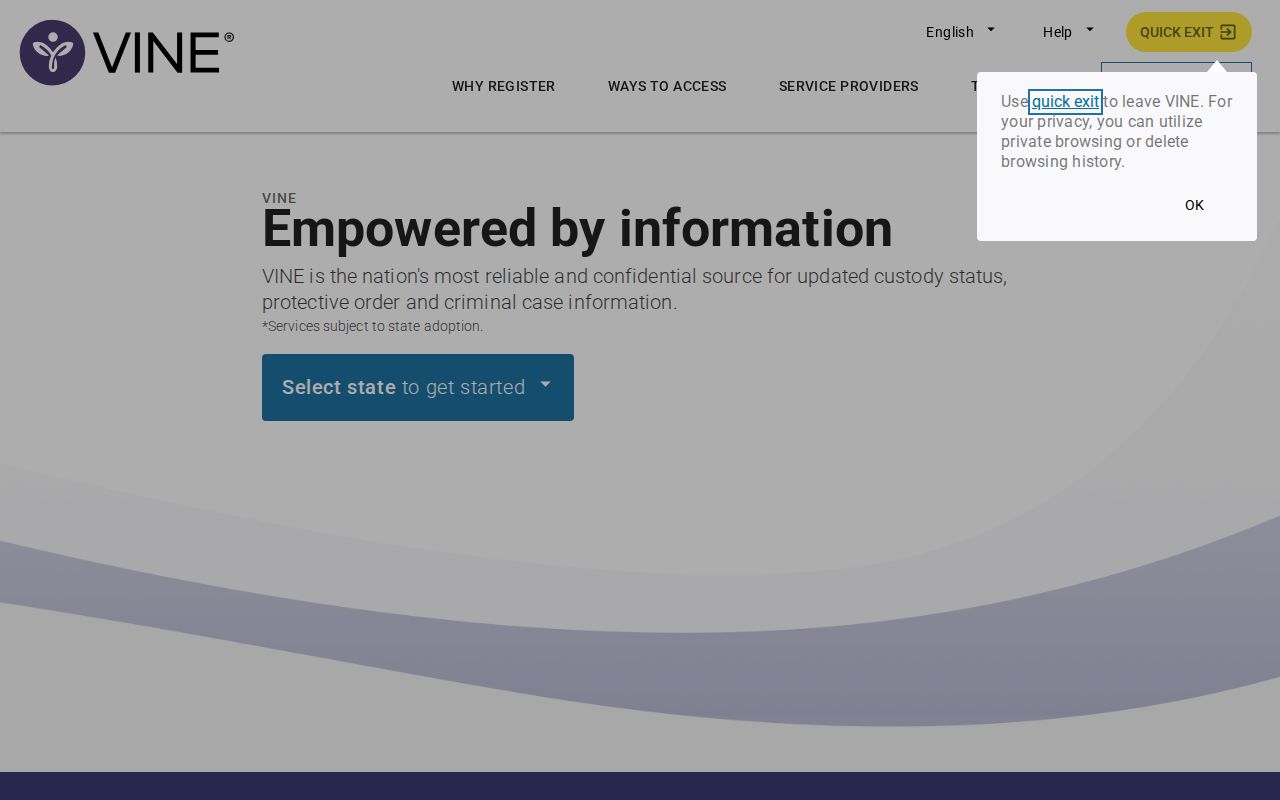
The state choice is the first routing step because custody data is supplied through participating agencies within the selected jurisdiction.
Virginia state-prison notification is separate. VADOC now uses NAAVI, or Notification and Assistance for Victim Inclusion, for eligible victims and qualifying family members. Jail VINE registration does not transfer into NAAVI. State-custody eligibility and enrollment must be handled through the VADOC program.
Run a Virginia VINELink Inmate Check
Begin at the Virginia VINELink page and search one person with the identifiers offered by the interface. Use the most exact name or ID available. A common name may return more than one record, so the agency, identity details, and custody location should agree before the result is treated as a match.
- Select Virginia. Confirm that the interface is searching the Commonwealth’s participating local and regional jail records.
- Enter the person’s identifiers. Use the available name or ID fields without adding guesses that could hide the record.
- Compare possible matches. Check the reporting facility and identity details rather than relying on the name alone.
- Open the matching record. Read the current custody event, facility, and offered notification options.
- Confirm a release or transfer. Contact the reporting jail or next custodian when the destination is unclear.
If no record appears, do not conclude that release occurred. The jail may not participate, the spelling or ID may be wrong, the feed may lag, or the person may be held by a source outside Virginia Jail VINE. Check the last known jail, VADOC, BOP, ICE, or court record as the facts require. A live jail roster also answers current custody only and may not preserve a completed release transaction.
Note: A negative Virginia VINELink search is inconclusive until the likely custodian and the person’s identifiers have been checked.
Virginia VINELink Release Fields
The exact interface and agency-supplied fields may change. Read the labels shown on the matching record rather than assuming a universal result card. Virginia’s official materials identify custody events such as release, transfer, death, escape, and return, and note that some agencies may supply more events.
| VINELink item | What it can establish | What it cannot establish alone |
|---|---|---|
| Person identifier | Helps distinguish records with similar names | Identity without comparison to other details |
| Reporting jail | Names the agency supplying the event | Every prior or later custodian |
| Custody status or event | Shows the jail’s reported change | The legal reason for every change |
| Release event | Shows departure from that reporting jail | Guaranteed entry into the community |
| Transfer event | Signals movement away from the reporting jail | The final outcome without the receiving agency |
| Notification options | Shows channels offered for that record | A promise that all later agencies are covered |
A court disposition, jail release transaction, and VINE event often need to be read together. The court can explain bond, dismissal, sentence, or a later order. The jail can confirm the date, time, release type, and transfer destination it recorded. VINELink adds a notice and a public custody-status route, but it does not replace those maintained records.
Register Virginia Jail Release Alerts
After opening the correct record, select an offered notification channel. Virginia materials list telephone, text, email, TTY, and in-app notice. The options available on one record may differ from another agency’s feed. Registration can also be completed through the published Virginia Jail VINE number, 1-800-467-4943.
- Verify the matching record. Register only after the person and reporting jail have been checked.
- Select the available channel. Choose telephone, text, email, TTY, or in-app notice as offered.
- Supply the requested contact details. Follow the prompts for that channel and review them for accuracy.
- Create the telephone PIN. If registering for calls, keep the PIN available for the alert.
- Acknowledge the call. Entering the PIN when a telephone alert arrives confirms receipt and stops repeat calls.
- Verify the event. Contact the reporting agency when “release” or “transfer” does not state the destination.
Notification is tied to the record and agency feed, not to every future custody system. If the person transfers, review whether the receiving agency has its own registration. Keep contact details current in the service. An alert can arrive after the underlying agency update, so it should not be used to predict an exact exit time.
Virginia Jail VINE Versus NAAVI
Virginia’s most important notification quirk is the separation between jail and state-prison systems. Jail VINE covers participating local and regional jail events. VADOC NAAVI is the current state-custody program and is restricted to eligible victims and qualifying family members. A registration in one does not enroll the person in the other.
This matters when a state-responsible person remains in a local jail. A Jail VINE “release” or “transfer” may describe movement from the jail into VADOC, not freedom from correctional custody. Eligible users who need both layers must register separately and ask the agency to clarify an alert that lacks a destination.
| Virginia system | Custody layer | Registration | Release meaning |
|---|---|---|---|
| Virginia Jail VINE | Participating local and regional jails | VINELink or the published jail VINE telephone route | Departure from the reporting jail, which may be release or transfer |
| VADOC NAAVI | VADOC state custody | Separate eligibility-based VADOC process | Anticipated or actual state-custody event as identified by VADOC |
NAAVI can provide an anticipated-release notice, commonly about thirty days before the expected date, and a separate actual-release notice when VADOC custody ends. VADOC states that notifications stop after release. The anticipated notice is a forecast and can move. The actual notice reports the state-custody event, though a detainer or another custodian may still control where the person goes.
Note: Virginia Jail VINE and VADOC NAAVI require separate registrations and describe different custody layers.
Virginia VINELink Check Limits
VINELink does not replace the federal Bureau of Prisons locator. For federal custody, search the official BOP database by register number or name. BOP can report Released or Not in BOP Custody, but either status answers only the BOP question. It does not rule out state, local, immigration, or another federal custodian, and it does not describe federal supervised release.
Immigration custody also uses a separate source. ICE’s Online Detainee Locator searches by A-number and country of birth or by exact biographical fields and country of birth. ICE says its public tool includes certain people released from ICE custody within the prior sixty days. That is a short window, not a permanent archive.
For a local jail event, ask the sheriff or regional jail for the correctional status, release date and time, disposition or release type, and transfer destination. For VADOC custody or supervision, use the state locator and maintained records. Court dockets can explain the order behind a change but generally do not prove the moment jail out-processing ended.
Confirm Virginia Release After Alerts
A strong release check preserves three layers. First, identify the last custody record. Second, find the legal authority, such as bond, dismissal, sentence completion, parole, a court order, or transfer. Third, confirm the jail or facility transaction and destination. A VINE alert is valuable evidence of a reported custody change, but it is only one layer.
When the online result is gone or unclear, request the existing release transaction from the agency that held the person. Include the full name, booking or DOC number, date range, facility, and requested fields. For a jail record, ask for release date and time, release type, and transfer destination. For a state record, ask VADOC for the release or discharge fields it maintains.
Do not treat a person’s absence from the roster as proof of release. A transfer can remove the name just as a community exit can. Search the likely receiving custodian if one is recorded. The full Virginia released-inmate verification process separates local, state, federal, immigration, and court sources when one alert cannot settle the outcome.
Virginia Anticipated Versus Actual Alerts
An anticipated release notice is forward-looking. It reflects the expected date then held by the state-custody system and can change after a corrected order, credit change, disciplinary event, warrant, detainer, or other legal event. NAAVI may provide eligible users with such notice about thirty days before the expected date. It then sends a distinct actual-release notice when VADOC custody ends.
Virginia Jail VINE events use the reporting jail’s feed and should be read by their displayed label. A jail release alert may come after the local event posts. A transfer alert points away from the reporting jail but may not state every later step. In both systems, notice time and event time are different fields. Confirm the agency’s maintained transaction when exact timing matters.
Notifications stop being useful as historic archives once their operating scope ends. Save the needed alert details, then obtain the source record from the jail or VADOC. A release record can preserve the legal authority, date and time, release type, and destination more clearly than an old message.
Route Virginia Alerts by Custodian
Start with the agency named on the alert. A county, city, or regional jail holds its booking and release transaction. VADOC holds state commitment, computation, prison-release, and supervision records. BOP handles federal custody. ICE handles immigration detention. The court explains bond, sentencing, revocation, and later orders but usually cannot confirm the moment the jail finished out-processing.
If a local alert reports transfer, ask for the receiving destination. A state-responsible person can leave a regional jail and enter VADOC. A jail can also transfer someone to another locality, federal authority, or immigration custody. The new custodian’s locator or records office becomes the next source. Do not keep searching the old jail and interpret the missing name as community release.
For a federal search, BOP records from 1982 forward can show Released or Not in BOP Custody and may include a past release date. For ICE, the public locator covers current custody and certain people released in the prior sixty days. These sources have different historic reach, so a negative result means something different in each one.
Request Virginia Release Event Records
When an alert is ambiguous, request the existing record behind it. Give the agency the person’s name, booking or DOC number, facility, date range, and event shown. For a jail, ask for correctional status, release date and time, disposition or release type, and transfer destination. For VADOC, ask for projected and actual release fields, last custody location, transfer destination if releasable, and current or completed supervision status.
A narrow request is better than asking the agency to explain “what happened.” Virginia FOIA applies to existing public records and contains exemptions. It does not require the custodian to create a new report. Ask for electronic delivery and an advance cost estimate if the search may be substantial.
The record request also resolves feed limits. A notification can be late, a record can leave the public interface, and registration may not follow a transfer. The maintained transaction belongs to the agency that created it and provides the durable source for the reported event.