
Virginia VADOC Release Search Scope
The official Inmate & Supervisee Locator covers people in VADOC custody or under VADOC supervision. That group includes people in state correctional facilities, probationers, parolees, people at institutional hospitals, some people held in local or regional jails under VADOC authority, and Community Corrections Alternative Program participants. The tool is therefore useful after a prison departure when a person remains on parole, probation, or another covered form of supervision.
Its stated scope does not promise a permanent released-person archive. Someone can leave a prison and remain searchable through a district-office placement because legal supervision continues. By contrast, someone who has finished both confinement and supervision may no longer fall within the locator's current scope. A missing result does not prove release, final discharge, or arrival in the community. It may reflect a spelling issue, completed supervision, transfer to a jail, federal or immigration custody, or a recent change that has not reached the daily update.
Use the VADOC Offender Search
Begin with the least restrictive reliable search. VADOC permits a search by identity or DOC number. A name search needs at least the first three letters of the first name and the full last name. A DOC-number search uses the seven-digit DOC ID. Location, race, gender, and age range are optional filters. The disclaimer must be accepted before the Locate command becomes the final search step.
- Open the official locator and read its accuracy and timing warning.
- Enter the seven-digit DOC ID when known. Otherwise, use the required parts of the legal first and last name.
- Leave optional filters open at first. Add one only when the broad result set needs to be narrowed.
- Compare the DOC number and identity details before deciding that a result identifies the right person.
- Read the placement as custody or supervision, then confirm any date through the proper record custodian.
A legal name can work better than a nickname. If the first attempt fails, try a permitted spelling variation before assuming the person has left the system. Do not stack all filters at once because an old location or age entry can hide a valid match. The seven-digit DOC ID is the best key when two people have similar names.
The VADOC locator is updated daily, and the agency warns that its information can be inaccurate or outdated. A same-day departure, court order, sanction, or transfer may not appear at once. Check the last institution or supervising district when the timing matters.
Virginia Corrections Source Check
The VADOC home page is the source shown in the available statewide capture.
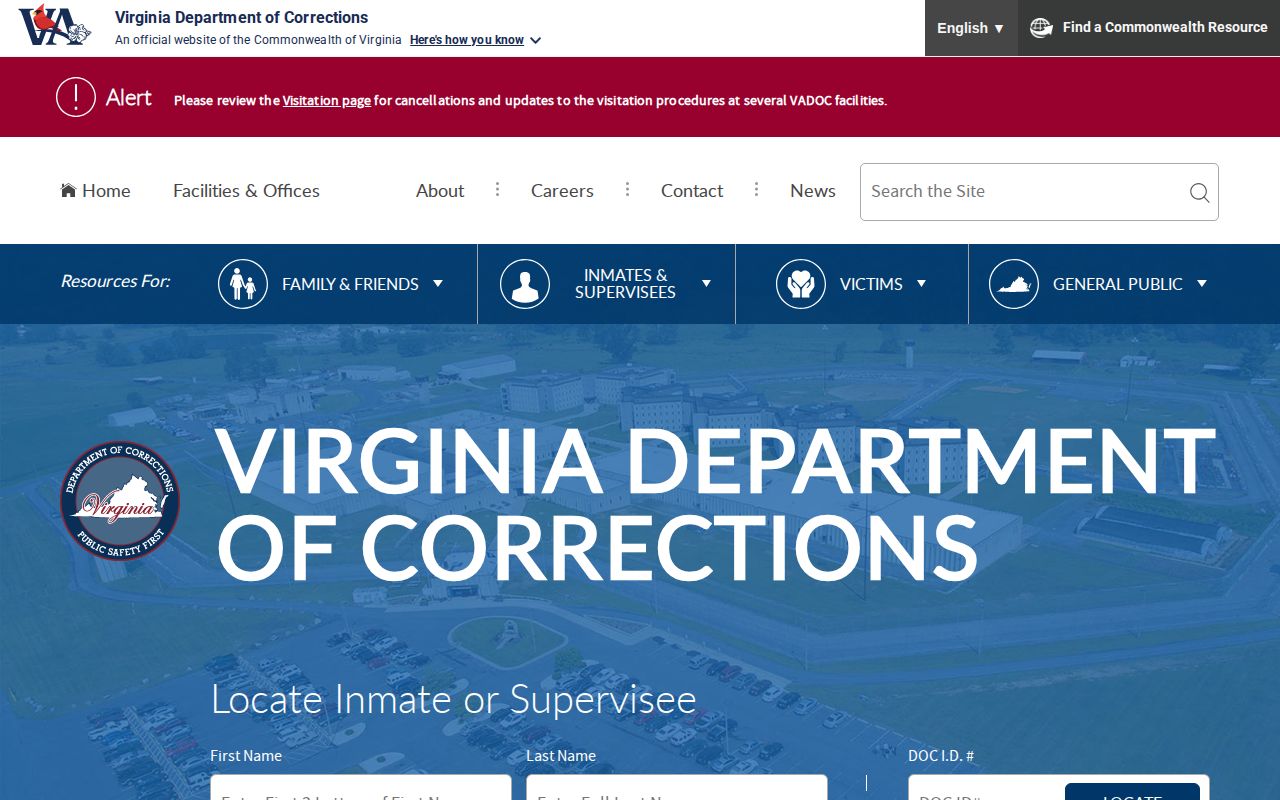
The agency navigation is the reliable starting point for its locator, facilities, release procedure, time-computation material, and records-request instructions. The capture is not a person-level result and does not establish anyone's custody or release status.
Read VADOC Release Results Carefully
Custody and supervision are separate. A state-facility or local-jail placement means the person remains confined. A probation, parole, or district-office placement usually means the person is in the community under supervision, though another custodian or a short sanction can complicate the facts. A CCAP placement is still a correctional program status. It should not be called unrestricted discharge.
VADOC does not publish a result-card data dictionary that guarantees one universal Released or Discharged label, an actual-release-date field, a release-type field, or a set retention period for completed records. For that reason, the absence or presence of a particular screen label should not be converted into a statewide promise. Operating Procedure 010.3 does state that staff may confirm location, commitment name, DOC number, offense, sentence length, projected release date, and parole eligibility date, within the procedure's limits.
| Information | Safe reading |
|---|---|
| DOC number | A seven-digit identifier used to distinguish people with similar names. |
| Facility placement | Evidence of current confinement, not a community release. |
| District or supervision placement | Evidence that VADOC supervision may continue after physical release. |
| Projected release date | An official forecast that can change, not proof that release processing occurred. |
| No result | Not proof of release or discharge; use court, jail, VADOC, or other custodian records. |
Reliable release confirmation has three layers. Identify the last custody record, establish the legal authority and computed date, and then confirm the actual release or transfer transaction. A parole grant, court order, projected date, and notification alert can each supply one piece. None proves community arrival in every case.
Note: A projected date describes the calculation then in force, while an actual release record documents the completed facility event.
Virginia Prison Release and Discharge
Virginia uses release to describe several ways a person can leave confinement. A state prisoner may leave through discretionary parole when legally eligible, mandatory parole under an older sentence regime, conditional release under a specific law, the credit-adjusted end of active incarceration, a court order, or transfer to another custodian. Physical departure does not always end the sentence.
Discharge is the end of the relevant custody or supervision duty. A parolee serves the remaining term in the community under conditions. A probationer can be out of confinement while still subject to a suspended sentence. Even final VADOC discharge does not decide whether a separate case or another jurisdiction still imposes an obligation.
Virginia generally ended ordinary discretionary parole for felony offenses committed on or after January 1, 1995, subject to statutory exceptions. Older parole-eligible sentences and special categories remain. The Virginia Parole Board makes discretionary parole decisions. VADOC computes dates, maintains custody, prepares the departure, and administers community supervision. For a qualifying older sentence, Virginia law can provide mandatory parole six months before final release, but exceptions and Board authority make that a conditional form of release rather than a flat sentence cut.
- Projected release date
- A forecast based on the sentence and credits known at that time.
- Parole
- Conditional release from confinement while part of the sentence remains under supervision.
- Detainer
- A hold or request from another authority that can turn release into a transfer.
- Discharge
- The end of the relevant VADOC custody or supervision obligation.
VADOC Release Date Computation
VADOC calculates qualifying state-responsible sentences, while a local jail may calculate a shorter local term. The sentence order, jail credit, concurrent or consecutive structure, earning system, disciplinary record, and later sentence events all affect the projected date. A corrected order, added jail credit, new sentence, credit-class change, lost or restored credit, or detainer can move it. No sound calculation comes from sentence length alone.
Two earned-time systems can matter. Older parole-eligible Good Conduct Allowance sentences use classifications that can range from no credit to thirty days for each thirty days served. Modern Earned Sentence Credit rules distinguish listed ESC-1 offenses, which can earn up to 4.5 days per thirty days served, from other eligible ESC-2 sentences, which can earn up to fifteen days per thirty. Eligibility, conduct, assigned programs, mandatory minimums, and offense dates still control.
The common phrase “85 percent rule” is not a safe universal formula. The top ESC-1 rate works out to about 86.96 percent of credit-adjusted time, while other eligible sentences may use different rates and some time earns less or no credit. The VADOC time-computation material and the individual record are better sources than a rough percentage.
VADOC Release Processing Checks
A scheduled date does not release a person by itself. Before departure, staff verify identity, sentence computation, court orders, warrants, detainers, disciplinary matters that affect credits, and the approved release plan. An unresolved sentence can delay the event. A detainer can send the person directly to another jail or agency, so the VADOC custody period can end without release to the community.
Release planning also addresses transportation and other arrangements. VADOC's procedure says the business office can arrange bus transportation when needed. If no transport has been arranged, the facility selects an economical mode and purchases or arranges the ticket rather than handing out travel cash. A direct discharge without supervision may request a ticket to a Virginia destination. A person leaving to probation or parole is routed to the approved Virginia home-plan location, subject to interstate rules.
Actual release should be confirmed with the facility transaction or a focused VADOC record. The projected date establishes what was expected. The transaction shows what happened, including whether the person departed, stayed due to a new legal event, or transferred to another custodian.
Virginia Release Funds and Transport
Virginia's release-day rules are more exact than the loose phrase “gate money.” Unless a person must meet a detainer, VADOC pays all posted Offender Pay funds at release. When that balance is below $25, the agency adds enough to reach $25. Funds posted after departure are forwarded within five business days. These rules describe the VADOC process, not county-jail releases.
Medical staff may provide up to thirty days of discharge medication and supplies. Personal property is returned, state-issued clothes are collected, and discharge clothing may be supplied when needed. The transport plan depends on supervision, destination, and whether another authority takes custody. The releasing institution should confirm current arrangements for a named person.
A separate savings law generally directs ten percent of incoming inmate funds to a personal trust account until it reaches $1,000, subject to exclusions. That account may be paid on parole or final discharge. VADOC reported $12.1 million in such accounts at the end of fiscal year 2024. This savings balance is distinct from the $25 minimum applied to posted Offender Pay funds at departure.
Note: A transfer under a detainer ends one custody placement but is not a release into the community.
VADOC State Release Trends
VADOC's June 2026 cohort report counted state-responsible releases of 12,600 in fiscal year 2018, 12,692 in 2019, 12,774 in 2020, 11,574 in 2021, 10,080 in 2022, 12,202 in 2023, and 9,611 in 2024. The definition covers Virginia felons sentenced to at least one year and released from state-responsible incarceration. It includes releases from VADOC institutions and local or regional jails. It is not a count of every Virginia jail exit or necessarily unique people.
| Fiscal year | State-responsible releases | Research context |
|---|---|---|
| 2021 | 11,574 | Pandemic-era court constraints and release timing affected the period. |
| 2022 | 10,080 | The cohort remained below the pre-pandemic series. |
| 2023 | 12,202 | Retroactive Enhanced Earned Sentence Credit releases were concentrated early in the fiscal year. |
| 2024 | 9,611 | This remains a defined cohort, not a live release count. |
Supervision statistics measure something else. The December 2025 report counted 59,811 probation-and-parole cases at month end, down from 61,531 in December 2024. Those are cases, not a release count and not necessarily unique people. An FY2024 report gave an annual average of 62,016 people under community-based supervision, compared with 64,110 in FY2023. Month-end and annual-average measures should not be joined into one unlabeled trend.
Virginia DOC or Jail Records
VADOC holds state commitment, time-computation, prison-release, and community-supervision records. A county sheriff, city jail, or regional jail holds its own booking and release transaction. Someone freed on bond, recognizance, dismissal, time served, or a short local sentence may never have a VADOC prison-release record. Use the Virginia County Directory to reach the locality that operated the jail.
| Custody path | Primary source | What to request |
|---|---|---|
| State-responsible sentence | VADOC | Computation, release transaction, transfer, supervision, or discharge record. |
| County, city, or regional jail | Operating sheriff or jail authority | Booking status, release date and time, release type, or transfer destination. |
| Federal sentence | Federal Bureau of Prisons | Federal custody and release record. |
| Immigration custody | ICE | Immigration detention status through the authorized route. |
Disappearance from a live jail roster is not proof of community release. It can mean transfer to VADOC, another jail, federal custody, immigration custody, a hospital, or another lawful custodian. Request the transfer destination when available, then continue with that agency.
Request VADOC Discharge Records
For a fully discharged person, ask for narrow existing records tied to the name and DOC number. Useful fields include admission and release dates, recorded release type or legal authority, projected and actual date fields, time-computation summary, parole or mandatory-release instrument, last custody site, receiving agency if releasable, completed supervision status, and final discharge date or certificate if maintained. VADOC need not create a new report to answer an open question.
The VADOC FOIA process accepts requests by mail, fax, email, in person, or telephone, though the agency prefers writing. Identify the record with reasonable detail, include the requester's name, contact information, and legal address, request electronic delivery when practical, and seek an advance cost estimate for substantial work. Virginia FOIA applies to existing public records and allows exemptions and redactions.
- Identify the person, seven-digit DOC ID if known, last facility or district, and a useful date range.
- List the existing fields or records sought instead of asking VADOC to research an open-ended history.
- Send a person-level request to the unit manager, warden, superintendent, or probation-and-parole district chief that maintains the file.
- Use the central FOIA route when the correct custodian is unclear, and ask for an estimate before costly work begins.
- Compare the response with the court order and any receiving-custodian record when transfer remains possible.
General guidance is available through FOIA@vadoc.virginia.gov, the VADOC FOIA Officer at 804-963-2953, or VADOC, P.O. Box 26963, Richmond, VA 23261. Virginia law generally calls for an agency response within five working days, with defined response options and a possible extension of up to seven working days when the initial period is impractical.
An inactive former offender requesting the person's own file has a specific route under Operating Procedure 050.6. Form 050_F17 is titled “Request for Records (Inactive Offender Only),” and the request must be notarized for someone no longer housed in a VADOC facility. The procedure does not guarantee release of the whole case or medical file.